

Zoho One: A Practical Pathway for SMEs Ready to Grow, Organize, and Take Control
Many small and medium-sized businesses eventually reach a point where hard work is no longer enough. Sales are happening, customers are satisfied, the team is doing everything it can, yet behind the scenes things begin to feel scattered. Information sits in different places. Tasks are repeated. Important follow-ups are missed. Decisions become harder because leaders do not have a clear picture of what is really going on.
This is a common reality for many SME owners. They built their companies through grit, relationships, intuition, and persistence. But at a certain stage, sustainable growth requires structure. It requires systems. It requires clarity.
That is where Zoho One begins to change the story.
Zoho One is often described as a business operating system. It is more than a CRM. It is more than a collection of applications. It is a unified suite that brings sales, marketing, operations, finance, service, and analytics into one integrated environment — all at a price that makes sense for small and mid-sized organizations.
Importantly, Zoho also brings credibility and scale behind its platform. Today, Zoho is a billion-dollar annual recurring revenue (ARR) company with millions of users worldwide. It is privately owned and profitable, which gives it long-term stability and independence. This is not a startup project or a tool that may disappear. It is a mature platform trusted by thousands of organizations across industries.
For SMEs, that level of strength and continuity matters. Business software is not just an expense — it is the backbone of operations.
Why Zoho One is Especially Relevant for SMEs
Some large enterprise systems are powerful but expensive and difficult to implement. At the other end of the market, lightweight tools are easy to start with but quickly show limits as the business grows.
Zoho One sits in between. It gives smaller businesses the enterprise-grade features they need without the complexity or cost barriers.

Zoho One is a cost effective and intuitive solution for Canadian SMEs looking to grow and scale their business. Try Free
A few differentiators include:
Affordability Compared to Competitors: Zoho One’s pricing model is generally more accessible than many leading platforms that require multiple add-on licenses or complex tiering.
Canadian Data Residency: Zoho offers data storage within Canada, which can matter for compliance, privacy policies, or customer trust.
Security and Compliance: Zoho One is SOC 2 compliant, meaning its systems meet recognized standards for security, availability, integrity, confidentiality, and privacy.
Comprehensive Suite: More than 40 applications under a single license remove the need for separate subscriptions to multiple vendors.
Private and Stable: Zoho’s private ownership and consistent profitability mean long-term support and development rather than unpredictable pivots.
Combined, these factors make Zoho One not just a toolset, but a strategic platform for future-ready growth.
Bringing Structure to Sales
Behind every growing business is a sales process, whether formal or improvised. Sales teams often begin with spreadsheets and email, which might work when there are only a few leads. But as the company grows, that informal system becomes fragile.
Zoho CRM changes that. It brings your sales pipeline into a central place where leads, opportunities, proposals, and follow-ups are tracked methodically. This type of structure helps teams know what to do next, prevents opportunities from slipping through gaps, and provides leadership with a real view of what is driving revenue.
Over time, sales becomes less reliant on memory or luck and more grounded in clarity and predictability.
Turning Marketing into Something Measurable
Marketing is often one of the first places SMEs invest energy. But many organizations still struggle to connect campaigns to revenue.
Zoho’s marketing tools allow companies to build campaigns, automate nurturing, capture leads directly into the CRM, and measure results more clearly. Suddenly, marketing becomes part of the growth engine rather than a series of disjointed efforts.
This shift enables SMEs to:
nurture prospects automatically while teams focus on meaningful strategy,
streamline messaging without juggling multiple platforms,
understand which campaigns truly generate qualified opportunities.
Creating Professional, Predictable Financial Management
Zoho Books and Zoho Invoice organize the financial side of the business so leaders can see where money is coming in and where it is going. Estimates flow into invoices, payments are tracked, and taxes are calculated correctly. Instead of running month-end with stress and surprises, business owners can finally see cash flow clearly.
This financial clarity is not just operational. It strengthens relationships with banks, accountants, and advisors because the data is structured and reliable.
Running Operations with Fewer Surprises
Zoho Projects and Zoho Creator help companies plan, track, and refine work processes. Managers see what is on schedule and where work is getting stuck. Resources are allocated with visibility, not guesswork. The result is smoother delivery and fewer urgent firefighting conversations.
Building Stronger Customer Relationships Through Support
Customer support becomes much easier and more proactive when all interactions are centralized. Zoho Desk brings service tickets from email, forms, and social channels into a single interface. This continuity leads to faster responses, clearer context, and stronger relationships. Small service problems become opportunities to impress.
Collaborating Inside the Company Without Confusion
Instead of lost attachments, long email threads, or delayed replies, teams can use chat, video, shared documents, and task assignments — all inside the Zoho ecosystem. Internal coordination becomes simpler, and teams spend less time searching and more time doing.
Making Decisions with Real Data
Zoho Analytics gives business leaders dashboards that show performance in real time. This includes revenue trends, customer retention, marketing ROI, and operational metrics. With accurate data on hand, decisions become less reactive and more strategic.
Is Zoho One Difficult to Implement?
One frequent concern from SMEs is whether implementation will interrupt daily work. The good news is that complexity is often a choice, not a requirement. By adopting a phased approach, companies can implement strategically without overwhelming teams.
A typical progression might look like this:
Stabilize the CRM and sales processes.
Introduce marketing automation and lead capture.
Add invoicing and financial workflows.
Layer in operational planning tools.
Connect dashboards for real-time insight.
This step-by-step adoption makes the transition feel like a journey instead of a disruption.
How Zoho One Compares to Other Platforms
To understand the real value of Zoho One, it helps to look at how it stacks up against other widely used business platforms.
Common alternatives include:
Salesforce
HubSpot
Microsoft Dynamics 365
Oracle NetSuite
SAP Business One
These platforms are powerful and popular, particularly in larger enterprises. But for many SMEs, they often come with challenges:
❌ Higher total cost of ownership
Multiple add-on modules and licensing layers often mean paying more per user than expected.
⏳ Longer, more complex implementations
Deployments may require external consultants and long project timelines.
📈 Escalating pricing as you grow
Adding features, automations, or integrations can quickly push costs upward.
🔧 Ongoing integration maintenance
Different systems must be connected and constantly managed to stay synchronized.
Why many SMEs find Zoho One more practical
With Zoho One, the experience is different.
Instead of paying separately for CRM, marketing automation, support, finance, project management, and analytics, organizations receive the entire suite under one unified license.
💡 This can be especially valuable for small and mid-sized businesses that need enterprise-level capabilities without enterprise-level costs.
Most SMEs that switch to Zoho One report:
✔ Lower monthly software spend
Fewer subscriptions to manage, fewer surprises.
✔ Lower implementation costs
Native integrations reduce reliance on outside consultants.
✔ Simpler administration
One ecosystem instead of juggling multiple vendors and contracts.
✔ Higher team adoption
A consistent interface makes tools easier to learn and use.
In real terms, businesses that once paid hundreds or even thousands per month across different SaaS tools often find they spend significantly less with Zoho One while gaining more functionality.
And importantly, the cost savings do not mean compromise. Zoho continues to invest heavily in innovation and platform security. With SOC 2 compliance and the ability to store data in Canada, SMEs gain a secure, future-ready platform that supports growth with confidence.
A simple cost example: competitors vs Zoho One
Let’s look at a realistic scenario.
Imagine a growing SME with 15 employees that needs:
a CRM
marketing automation
customer support/helpdesk
project management
invoicing and basic accounting
dashboards and analytics
What most companies pay with separate competing tools
This is what a typical monthly software stack might look like using well-known competitors (CRM + marketing tool + support desk + accounting + project management + BI):
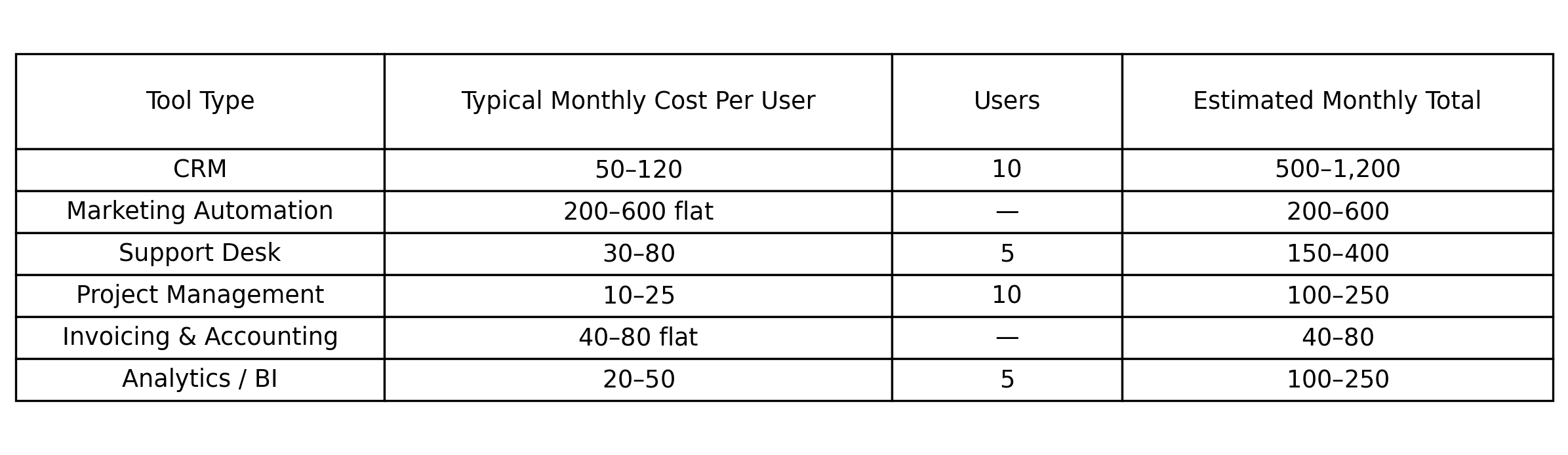
Typical monthly software stack might look like using well-known competitors (CRM + marketing tool + support desk + accounting + project management + BI)
Compare: Traditional Software Stack vs. Zoho One
Estimated competitor stack total:
👉 $1,090 to $2,780 per month
and this does not include integration work, maintenance, or consultant fees.
➡ Multiple tools from different vendors
➡ Separate logins for every system
➡ Extra costs for integrations and add-ons
➡ More complexity to manage and maintainNow compare that to Zoho One
Zoho One
For SMEs, Zoho One typically comes in at 30%–60% less overall
➡ All-in-one suite (CRM, marketing, finance, support, projects, and more)
➡ Built-in, native integrations
➡ Simpler administration
➡ Fewer surprises — more control
With Zoho One, the same company typically pays a predictable, unified subscription that often lands far below that range, while gaining access to more than 40 integrated apps.
With Zoho One, that same organization receives access to:
CRM
marketing automation
support desk
project management
finance tools
collaboration
analytics
plus dozens of additional apps
All under one unified subscription.
This difference becomes even more meaningful when you consider the hidden savings:
✔ less time managing vendors
✔ fewer integration breakdowns
✔ faster onboarding for staff
✔ clearer data, fewer errors
In real terms, many businesses discover that Zoho One allows them to reduce costs and increase capability at the same time.
And because Zoho is SOC 2 compliant, privately owned, and capable of storing data in Canada, SMEs gain financial efficiency without sacrificing security or trust.
Where Lead Prospect Fits In
Lead Prospect works with SMEs that are ready to bring order, alignment, and maturity to their systems. Our approach starts with understanding your business model, goals, customer journeys, and constraints. Only then do we configure Zoho One so it aligns with your strategy.
We support clients with both implementation and optimization. Our goal is always to help teams work smarter, not harder.
Webinars, Promotions, and Support
During January and February, Lead Prospect will host webinars designed for SME leaders exploring Zoho One. These sessions will walk through common use cases, practical tips, and ways to implement gradually without disruption.
We will also offer promotional onboarding options for businesses ready to start, along with a complimentary evaluation meeting. This meeting is an opportunity to review your current systems, map what’s working and what isn’t, and explore whether Zoho One is the right fit for where you are now.
In some situations, funding or support programs may be available depending on your sector, your project, or your location. We can help investigate these options so technology investments feel safer and more accessible.

See how intuitive ZOHO is and how many amazing apps you get for a fraction of the cost the competition. Everything your company needs to grow in one place.
What Zoho One Ultimately Represents
Zoho One is more than a collection of applications. For many small and medium-sized businesses, it represents a turning point. It signals the move from running day-to-day operations by feel and memory, to running with clarity, structure, and strategy.
Companies using Zoho One often describe the experience as gaining control. Processes align. Teams collaborate more naturally. Customers feel understood. Leadership feels confident about the future.
If your business is experiencing growth pains, complexity, or uncertainty about systems, Zoho One is worth exploring. Lead Prospect would be glad to walk through your options, answer questions, and help you determine the best path forward.
Growth does not need to mean chaos. With the right systems in place, it can feel intentional, structured, and sustainable — and Zoho One is a platform that helps make that possible.